




When you start thinking about extending your home, the idea feels exciting – more space, more light, a layout that finally works for your life. But choosing the right type of extension can feel like navigating a maze. Rear? Side? Wraparound? Loft? Garage? Basement? Each option solves a different problem, and each comes with its own set of considerations.
This guide walks you through the real-world decisions homeowners face – the practical ones, the design ones, and the “will this actually feel right to live in?” ones. And to make things easier, we’ll describe each extension type in plain, visual terms so you can picture how it fits with your own home.
Start by Looking at the Home You Already Have
Before you fall in love with glossy images on Pinterest, take a step back and look at your home’s shape, layout, and limits. The best extension isn’t the biggest – it’s the one that fits your property and your lifestyle.
Key things homeowners usually need to think about:
1. How your home is shaped
A detached home gives you freedom on all sides. A semi-detached gives you one open side. A terrace often only allows you to build at the rear or into the side passage.
Your existing form determines what’s realistic – and what’s not worth the fight with planning.
2. How much garden do you want to keep
More extension means less garden. Most homeowners want both.
The best design strikes a balance for daily life, not just square metres.
3. How natural light currently enters your home
Extensions that block key windows can create darker, tunnel-like spaces if they’re not planned well. Understanding where the sun hits your home helps you avoid that.
4. Access for construction
If everything has to go through the house, the job takes longer and costs more. Not a dealbreaker – but worth knowing upfront.
5. Your long-term plans
Are you staying for decades? Thinking of selling in a few years?
Different extension types add different types of value.
Once you understand your home’s starting point, choosing the right extension becomes far simpler.

Single-Storey Rear Extension
A rear extension pushes your home into the garden to create a brighter, more generous ground-floor space.
If your kitchen feels cramped or your living space doesn’t connect well to the garden, this is usually the go-to solution. Picture your back wall moved further out and replaced with wide doors, rooflights, and an open, airy space that changes the flow of your home.
Why homeowners choose this option
- You want a bigger kitchen or kitchen-diner
- You want an open-plan living area
- You want to improve access to the garden
- You want more natural light
Considerations to keep in mind
- The deeper you go, the more you lose from the garden.
- Large openings usually need structural support, which affects cost.
- Good glazing and thoughtful lighting make the space feel uplifting, not cave-like.
- Flat roofs, lanterns, or pitched roofs all create different moods.
Common challenge for homeowners
Rear extensions are simple in concept – but the layout decisions inside are where homes are made or broken. A great rear extension fixes the flow of your home, not just enlarges it.
Single-Storey Rear Extension Cost
A single-storey rear extension can cost anywhere from £2,200 to £3,200 per m².
Cost mostly depends on the functionality of the space – things like kitchen appliances, ventilation, heating, glazing, and how much structural work is needed. A minimal 20m² rear extension can land around £44,000, while an all-in, highly glazed, fully fitted kitchen extension can climb to £80,000 – £85,000 for the same size.

Side-Return (Side-Infill) Extension
A side-return extension fills in the narrow alley beside many period homes, turning “bin space” into valuable living space.
If you have a Victorian or Edwardian terrace or semi, you probably have a thin strip of land down the side that serves no real purpose. Building over it can widen your kitchen and make the whole ground floor feel less cramped.
Why homeowners choose this option
- Your kitchen feels long and narrow
- You want to widen the ground floor without losing garden depth
- You want more light in the centre of the home
- You want a practical extension that feels “natural” to the house
Considerations to keep in mind
- Blocking existing side windows means you’ll rely heavily on rooflights.
- The area is narrow, so construction can be slower.
- It’s a clever way to add floor area without pushing too far into the garden.
Common challenge for homeowners
Light. If the design doesn’t bring enough light from above, the widened space can feel dull. Rooflights become your best friend here.
Side-Return Extension Cost
A side-return extension generally costs £2,500 to £3,400 per m², mainly because the space is tight, access is limited, and roof glazing is usually essential.
Costs rise with high-end rooflights, drainage relocation and premium finishes. A simple 20m² side-return may cost around £50,000, while a fully fitted version with bespoke glazing can reach £65,000 – £68,000.

Wraparound Extension
A wraparound extension combines a rear extension and a side-return extension into an L-shaped design that transforms the entire ground floor.
If you’re dreaming of a spacious kitchen-dining-living hub – the kind that feels like the heart of the home – this is the big-impact option.
Why homeowners choose this option
- You want a full, open-plan family space
- You want zones for cooking, dining, relaxing and working
- You want to reshape the layout completely
- You want to maximise the ground-floor footprint
Considerations to keep in mind
- These extensions are deep – so lighting design is essential.
- They often require more steelwork and structural changes.
- They rarely fall under permitted development, so planning is usually needed.
- They can dramatically lift the lifestyle and value of your home when done well.
Common challenge for homeowners
Too much open space with no zoning can feel noisy or unfocused. The best wraparound extensions create clear “moments” within the space.
Wraparound Extension Cost
A wraparound extension typically ranges from £2,800 to £3,800 per m², as it combines both rear and side works and usually involves major structural openings.
Functionality (like a full kitchen), larger steel spans, and high-performance glazing affect the final cost. A modest-spec 20m² wraparound space starts from £56,000, while a high-spec, open-plan, fully integrated family space can reach £75,000 – £80,000+ for the same footprint.
Though wraparound extensions are usually way more spacious than 20m², but you get the idea.

Double-Storey Extension
A double-storey extension builds outwards on the ground floor and adds new space above at the same time.
If your home lacks bedrooms or bathrooms – and the ground floor needs work too – this offers the strongest value for money.
Why homeowners choose this option
- You want more sleeping space
- You want an en-suite or extra bathroom
- You want a bigger kitchen or living area downstairs
- You want to improve natural light and circulation across the home
Considerations to keep in mind
- The upstairs layout needs to align with your existing landing and bedroom flow.
- Privacy and overlooking matter more at upper level.
- The design should feel like a natural part of the house, not an add-on.
Common challenge for homeowners
Thinking about the home as a whole – not two separate floors. The best designs improve both levels in one coordinated move.
Double-Storey Extension Cost
A double-storey extension usually costs £2,800 to £4,000 per m² on the ground floor and £2,200 to £3,200 per m² upstairs.
The cost depends on whether the upper level includes a bathroom, the type of finishes, and how the new spaces integrate with existing rooms. For 20m² spread across two floors, a simple build can be £52,000, while an all-in solution with an en-suite and premium finishes can reach £70,000 – £72,000.
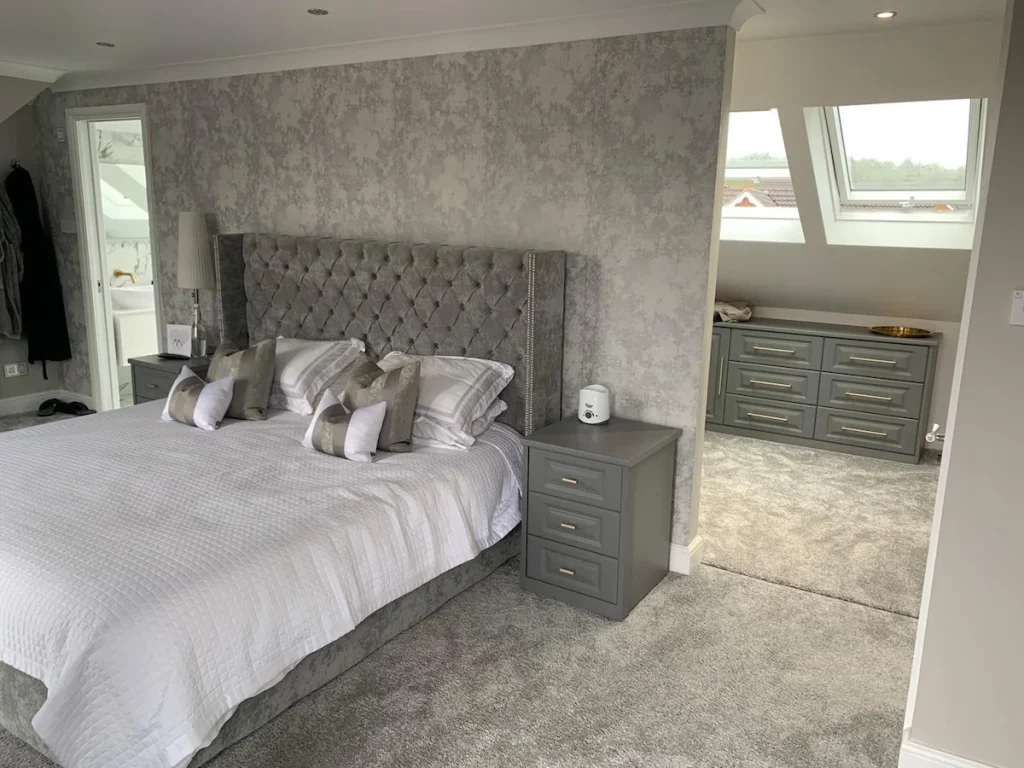
Loft Conversion
A loft conversion turns unused attic space into a bedroom, office or studio without altering your garden.
If your loft has enough height, this can be one of the most cost-effective ways to add a whole new room.
Why homeowners choose this option
- You want a peaceful, elevated bedroom
- You want a home office away from ground-floor noise
- You want to add value without touching the garden
- You want to make the most of every inch of the home
Considerations to keep in mind
- Head height is the first thing to check.
- Dormers offer more usable space than rooflights alone.
- Stairs need thoughtful placement so the loft feels part of the home.
Common challenge for homeowners
Lofts can feel dark or low if the wrong windows or dormer shapes are used. The right glazing placement makes all the difference.
Loft Conversion Cost
A dormer loft conversion normally costs between £2,200 and £3,000 per m², depending on insulation requirements, staircase design, glazing and the presence of a bathroom.
A basic 20m² loft conversion may cost £44,000, while a fully fitted dormer suite with an en-suite bathroom, roof windows and bespoke joinery can reach £65,000 – £70,000+.

Garage Conversion & Over-Garage Extension
Garage Conversion
A garage conversion turns an unused or underused garage into warm, practical living space.
It’s one of the quickest ways to gain a new room without changing your footprint.
Great for: playrooms, offices, guest rooms, utility rooms.
Over-Garage Extension
If your garage structure allows it, you can build a new room directly on top – often a bedroom or study.
Considerations for homeowners
- The existing garage may need strengthening
- Parking availability matters for planning
- The new room should connect logically to your upper floor
Common challenge
Ensuring the new space feels properly insulated and soundproofed – not like a converted bolt-on.
Garage Conversion/Extension Cost
A garage conversion is typically £800 to £1,400 per m², as the shell already exists and you’re mainly paying for insulation, flooring, internal walls and utilities.
A minimal conversion of around 15 – 20m² starts at £12,000, while a fully fitted room with heating, upgraded façade and high-spec finishes can cost £20,000 – £25,000.
Over-Garage Extension Cost
Building above a garage usually costs between £1,800 and £2,700 per m², but only if the existing foundations are strong enough.
If reinforcement is required, costs rise quickly. A simple 20m² over-garage room may cost £35,000, while a fully finished bedroom with proper insulation, windows and heating can reach £50,000 – £55,000.
Basement Extension
A basement extension digs below the house or garden to create an entirely new level of space.
This is a premium option used when above-ground space is limited.
Why homeowners choose this option
- You want a media room, gym, guest suite or playroom
- You have a compact plot in a high-value area
- You want major space without altering the look of the house
Considerations to keep in mind
- Basements are the most technical and disruptive extension type
- Excavation, waterproofing and engineering are significant
- Light wells and ventilation determine how it feels to live in
Common challenge
Balancing the cost with the lifestyle benefits. In the right homes and locations, the investment makes strong sense.
Over-Garage Extension Cost
A basement extension is the most premium option, costing £4,500 to £6,500 per m², mainly due to excavation, waterproofing, and structural work.
A basic 20m² basement may start at £90,000, while a fully finished space – with light wells, underfloor heating, ventilation systems and high-end finishes – can reach £120,000 – £130,000+.

Orangery vs Conservatory
Orangery
An orangery has solid walls, a lantern roof and large windows – it feels like a proper room that works all year round. Many homeowners use it as a dining room or second living room.
Conservatory
A conservatory is lighter and more glass-heavy. It’s bright and uplifting, but it can run hot in summer and cool in winter unless specified well.
Homeowner considerations
- How often you want to use the space
- Whether you want it to feel like part of the main home
- Orientation and heat control
- Furniture layout and privacy
Orangery Extension Cost
An orangery usually costs £2,000 to £3,000 per m², largely driven by glazing quality, lantern roof design, and integration with the existing house.
A basic 20m² orangery may be £40,000, while a high-performing, year-round space with premium doors and lighting can reach £55,000 – £60,000.
Conservatory Extension Cost
A conservatory is typically £1,200 to £2,000 per m², depending on frame quality, glass performance and heating.
A minimal 20m² conservatory may cost £24,000, while a fully insulated, high-spec version that feels more like a permanent room can climb to £35,000 – £40,000.

Kitchen Extensions: A Category All Their Own
Most extensions revolve around the kitchen. It’s where families spend most of their time.
If you’re thinking kitchen-first
- Focus on natural light
- Plan storage early
- Decide how cooking, dining and relaxing will flow together
- Think about views – both inside and outside
- Keep circulation clear so the room feels calm, not chaotic
The right kitchen extension changes the way you live every single day.
What Homeowners Often Find Challenging
Choosing an extension type isn’t about picking from a menu – it’s about choosing the upgrade that truly improves how you live.
Homeowners typically struggle with:
- Light: Will the new space feel bright or boxed-in?
- Flow: How will rooms connect and move together?
- Garden: How much outdoor space are you comfortable trading for indoor comfort?
- Planning: What will your council allow?
- Budget: Where should you invest, and where can you save?
- Value: Which extension adds long-term appeal?
The right extension feels natural – as if the home should always have been this way.
Conclusion: Choosing the Right Extension for Your Life
Your extension is more than extra metres – it’s a chance to reshape your home around the way you live.
When you understand your property, your lifestyle, and the role each extension type plays, the decision becomes clear:
- Rear extensions open the home to the garden
- Side returns widen tight layouts
- Wraparounds create full family spaces
- Double-storey builds balance living and sleeping
- Lofts add calm, elevated rooms
- Garage conversions unlock underused space
- Basements create whole new worlds underground
- Orangeries and conservatories add light-filled charm
When you choose the extension that fits your life, the transformation feels effortless every day that follows.
Ready to explore your extension options?
If your home feels like it’s almost perfect – just missing that extra space or better flow – let’s talk. We’ll help you understand what will work, what won’t, and what will make the biggest difference to your everyday comfort.

