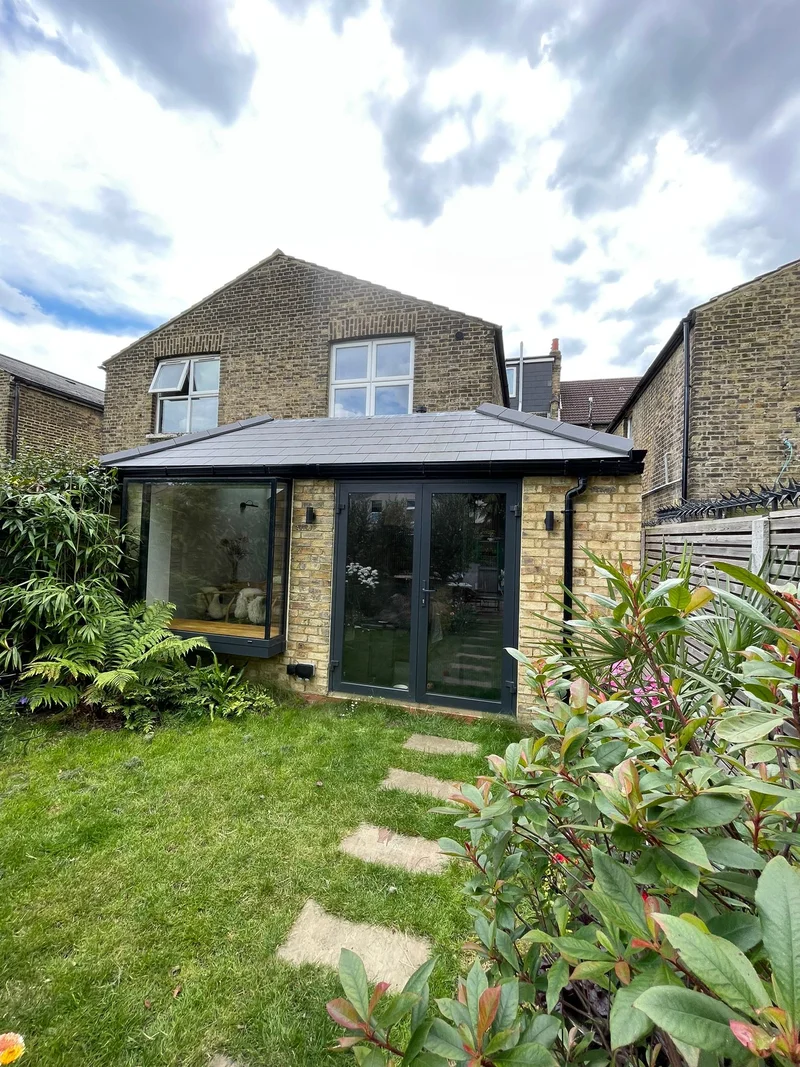


When you’re extending your home, one question always comes up early: Do you build with timber frame or brick?
It’s not a simple cost question. It’s about how your home behaves, feels, and performs for decades.
Let’s compare the two, the right way – by what actually matters to South London homeowners.
Timber Frame Construction: Quick, Precise, and Eco-Smart
A timber frame extension is a structural shell made from precision-engineered wooden panels.
Most are prefabricated in factories, then assembled on-site like a smart puzzle.
The big benefits:
- Speed: On-site build times can be up to 20% faster than brickwork.
- Energy performance: U-values as low as 0.18 W/m²K mean serious insulation.
- Cleaner process: Less noise, waste, and site disruption.
- Sustainability: Timber is renewable and stores carbon instead of emitting it.
Best for:
Busy families who want a quick, efficient build with strong sustainability credentials.
Brick Construction: Solid, Lasting, and Familiar
Brick is the traditional British way to build – and for good reason.
It’s durable, weather-resistant, and looks right at home alongside London’s period architecture.
Why brick remains unbeatable:
- Longevity: 100+ years with minimal maintenance.
- Thermal stability: Bricks absorb and release heat slowly, keeping interiors steady.
- Noise control: Dense walls make for quiet rooms, especially near main roads.
- Visual match: Perfect for extensions on Victorian or Edwardian homes.
Best for:
Heritage homes or those in conservation areas, where matching existing facades is essential.
Head-to-Head: Timber vs. Brick Comparison
| Factor | Timber Frame | Brick |
|---|---|---|
| Build Speed | 10 – 20% faster | Slower, weather-dependent |
| Wall cost, per m² of wall (South London) | £190 – £230 per m² of wall, with K-render finish | £220 – £290 per m² of wall, depending on facing brick type |
| Insulation (U-value) | 0.18 W/m²K | 0.18 W/m²K |
| Durability | 40 – 60 years | 100+ years |
| Sustainability | Renewable, low carbon | High embodied energy |
| Maintenance | Needs resealing | Minimal |
| Aesthetic Fit | Contemporary homes | Heritage homes |
| Resale Value | High for modern builds | Excellent for traditional homes |
Costs: Where the Real Differences Show
A timber frame extension in South London generally costs less per square metre and finishes faster, reducing labour costs.
The figures in the table above cover the external wall construction only, measured per square metre of wall. They are not the price of a finished extension. A single-storey extension in London costs £2,300 to £3,400 per m² of floor area to build, whichever structure you choose (HomeOwners Alliance, 2026). For the full picture, see our breakdown of house extension costs in South London.
But brickwork wins in long-term value, especially in older neighbourhoods where buyers expect that look and feel.
What affects cost the most:
- Access: Narrow South London roads can add logistics fees.
- Complexity: Wraparound or two-storey builds add structural planning.
- Finish quality: Brick facades and bespoke joinery raise costs, whichever structure you choose.
Pro insight: We often combine methods – timber for speed and structure, brick for exterior finish – to balance budget, strength, and visual appeal.
Planning Permission in South London: The Facts That Matter
Here’s where most homeowners get tripped up – not by materials, but by planning rules.
Every London borough has its quirks. We deal with them every week.
1. Council Differences
- Southwark & Lewisham:
Timber frames are usually fine under permitted development, as long as materials are “in keeping” with the main house.
Brick is preferred in conservation zones.
- Greenwich & Bromley:
Tend to be stricter on visible changes – external finishes must “match existing” for front or side extensions. - Bexley:
More flexible for rear extensions if height and boundary limits are respected.
2. What Actually Needs Permission
You’ll need planning approval if:
- Your extension goes beyond 3m (terrace/semi) or 4m (detached) at the rear.
- The structure changes the street-facing appearance.
- Your property is listed or within a conservation area.
3. Building Control Still Applies
Even if you don’t need planning permission, you’ll still need Building Control approval. It’s one of five fees most quotes leave out; see the costs nobody quotes you.
For timber frames, that means proving:
- Fire safety compliance (Class 0 or Euroclass B materials).
- Proper acoustic insulation.
- Adequate structural bracing and vapour barriers.
Rapid Bee insight: We handle all applications in-house – from drawings to compliance reports – so you don’t get caught in paperwork ping-pong.
Sustainability and Environmental Value
If sustainability ranks high for you, timber takes the crown.
Every cubic metre of timber stores roughly 1 tonne of CO₂. Brick production, by contrast, releases around 250 kg of CO₂ per tonne.
But longevity matters too.
Brick extensions often last over a century – reducing rebuild frequency and embodied carbon over time.
For us, sustainable house extensions are about balance – not buzzwords.
Design Integration: Blending New and Old
If your home’s style is classic London – red brick, sash windows, slate roof – you can still modernise without clashing.
Timber doesn’t mean “Scandi box”.
It can hide behind a brick skin, a render, or cladding that matches your home’s tone perfectly.
This gives you the structural benefits of timber with the timeless look of brick.
So, Which Should You Choose?
- Choose Timber Frame if you want:
Speed, energy efficiency, and flexibility.
- Choose Brick if you value:
Longevity, traditional aesthetics, and lower maintenance.
- Choose Hybrid if you want:
Modern performance with timeless style.
If you’re still torn, book our free consultation.
We’ll run you through real build times, council constraints, and energy data for your specific property.
Why South London Homeowners Choose Rapid Bee
We’ve spent over a decade building house extensions across Southwark, Lewisham, Greenwich, Bexley, and Bromley.
We know which materials, councils, and suppliers make the process smooth – and which to avoid.
At Rapid Bee, you get:
- Straightforward advice from real builders.
- Full design, planning, and construction management.
- Precision builds – timber or brick, your call.
- Quality that earns back every pound spent.
See Our Recent Projects.
FAQs
Is timber frame suitable for two-storey extensions?
Yes. Modern systems use engineered timber like LVL beams, giving excellent load-bearing strength.
Can timber frames be used in conservation areas?
Yes, if the exterior materials match surrounding homes. The structure isn’t the issue – appearance is.
Does timber need more maintenance?
Only periodic resealing. Internally, it performs just like brick.
Which has better resale value?
Brick often edges ahead in traditional areas, but energy-efficient timber builds are catching up fast.
How long will each build type last?
A quality timber frame: 50 – 60 years. Brick: over 100. Both can last longer with maintenance.